hypernormalization
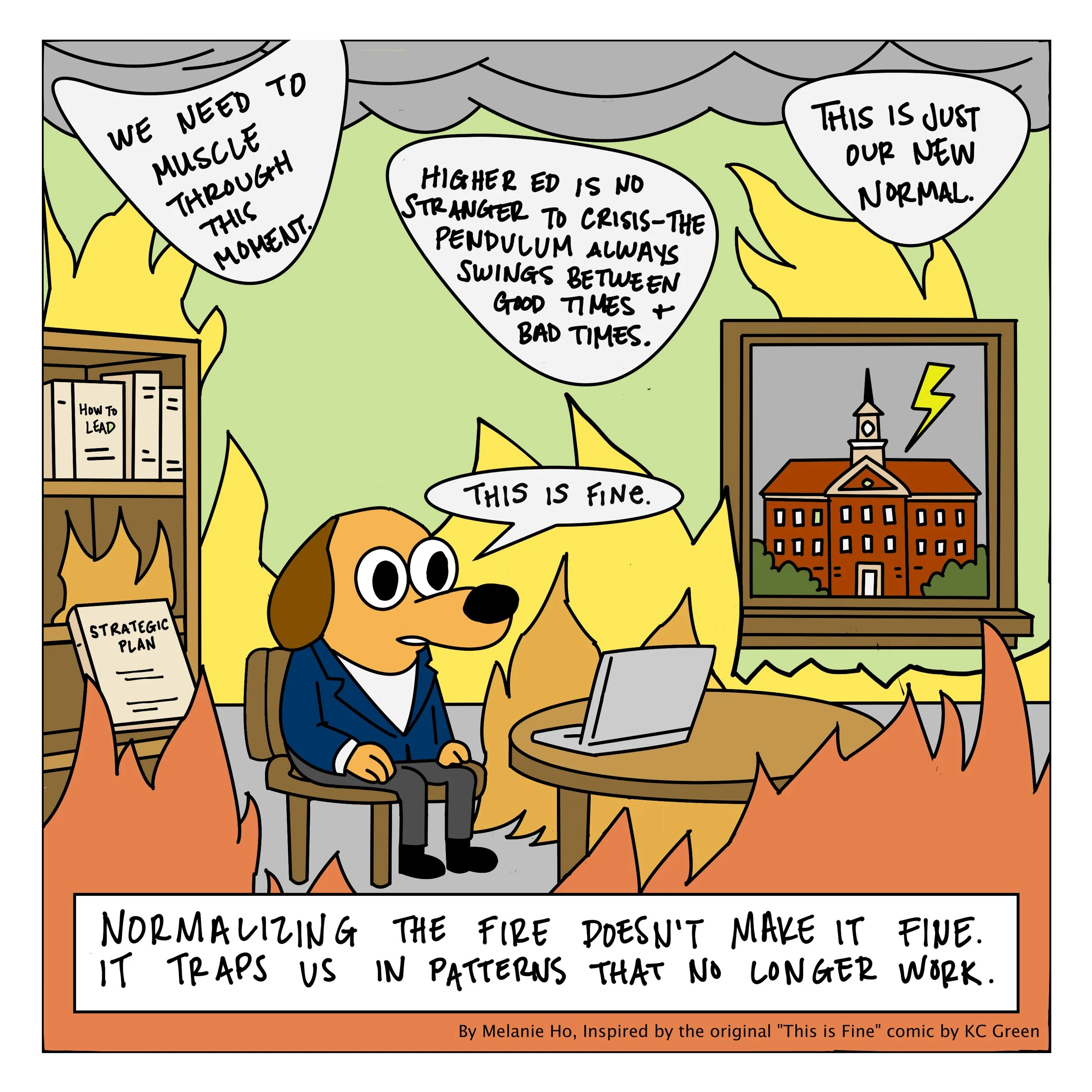
By Melanie Ho, inspired by the original "This is Fine" comic by KC GreenHypernormalization is what happens when we act as if “the way things are” is normal — or even okay — because imagining an alternative feels impossible. It shows up in the language we reach for in difficult moments: “this is just our new normal,” “the pendulum always swings back,” “we just need to muscle (or muddle) through.”
The words become a kind of spell. One that keeps us moving, but also keeps us from seeing clearly. That tension — between the impossible showing up and everyone just keeping going — is at the heart of University of the Surreal.
Where in your own work do you find yourself reaching for "this is fine" — and what might it be covering over?
What’s the difference between accepting what we can't control and normalizing what we shouldn't?
What's one pattern — in how you lead or work, how you respond to pressure, or how your team operates — that you suspect is no longer serving you?
What's your institution/organization's Goldfish Bowl right now?

a few things that shaped this story
For more about why I wrote this story, why I made it as a podcast, and why a campus setting, read my piece on Medium: Why a Goldfish Bowl? On Writing a Surreal Story for Surreal Times. More sources of inspiration and links to related resources can be found below.
-
In my workshops, one of the patterns that comes up most is the hypernormalization of leadership as a nonstop treadmill — the unspoken assumption that nonstop busyness is just what professional life must look like. There's always another fire, another crisis, another thing that comes before the things that matter most. “I'll get to that [important priority] after this one next thing.” But there’s always another next thing.
In Lewis Carroll’s Through the Looking Glass, Red Queen captures this idea when she tells Alice: "It takes all the running you can do, to keep in the same place."
A few relevant clips from my workshops or interviews:
-
When an image of a Goldfish Bowl on a university quad popped into my head as inspiration for University of the Surreal, I wasn't consciously thinking of novelist David Foster Wallace. For years, I'd been using his famous metaphor from a 2005 commencement address — two fish who don't know what water is, because they've never known anything else — in my work with leaders on culture, equity, and the invisible patterns that shape how we lead. It had become central to how I teach.
And yet when a giant fishbowl appeared in my imagination, I didn't make the connection. A few friends had to point it out — which is, perhaps, exactly the point.
As future seasons unfold, the Goldfish Bowl will carry more meanings than just this one. But the water we swim in — and whether we can learn to see it — will continue to be one of our major themes.
-
Alan’s doppelgängers in Episodes VII and VIII were inspired by many different sources — but all of them get to a central idea: that we each carry internal patterns that behave like voices in our heads. These voices can sometimes serve us. However, they can also run on autopilot, limiting what we see, feel, and think; and making it harder to adapt to changing conditions, set boundaries, and confront difficult truths.
Some of what I drew on:
Internal Family Systems (IFS) and parts work— the therapeutic framework developed by Richard Schwartz, which proposes that we all have distinct internal "parts" with different roles, fears, and intentions. Unlike models that pathologize these parts, IFS treats them with curiosity and care. Learn more here.
Sigmund and Anna Freud's psychological defenses — the classic framework for the ways we unconsciously protect ourselves from difficult emotions or truths. You can find a good overview of Freud’s defences in this book.
My Boundary Saboteurs model — six recurring patterns in how we unconsciously undermine our own boundaries under pressure. You can find a free self-assessment and resources on my website (and you will recognize some of Alan's doppelgängers there!) . Learn more here.
Inside Out and Inside Out 2 — Pixar's films are probably the most accessible popular culture expression of this idea — that our inner lives are populated by distinct characters with distinct agendas, and that growing up means learning to make room for all of them.
-
The Circle of Elders and what they represent will become clearer as the seasons unfold — we'll return to them.
What I’ll say now is this: Cassie's realization in the final moments of the season — that the leaders we need now are the ones that break the spells — draws on an idea from mythologist Martin Shaw.
From his book Courting the Wild Twin (Chelsea Green, 2020):
"Bad storytellers make spells. Great storytellers break them."
Read an excerpt here: "The Radical Power of Storytelling" by Martin Shaw

University of the Surreal is meant to be more than something you listen to — it's an invitation to reflect, discuss, and
perhaps see something you hadn't seen before.
If you’re curious about keynotes, workshops, and leadership development programs that go beyond “business as usual” — or one-on-one support — head over to melanieho.com.